Considering solar hot water for your Perth home? From what we’ve seen since starting Hot Water System Perth in 2021, the biggest hurdle isn’t usually the technology—it’s the roof itself.
You might be wondering if your property is actually ready for a roof-mounted system.
The reality is that while most Perth homes can support solar hot water, there is a big difference between a “possible” installation and an “optimal” one.
We find that many homeowners overlook critical factors like wind region classifications and structural load limits until it’s too late.
This guide breaks down exactly what our team looks for during a site inspection and helps you decide if a traditional roof-mounted system or a modern heat pump is the right call for your budget.
Let’s look at the specific requirements, the common pitfalls we see in local builds, and how to get the best result for your home.
Key Roof Requirements
1. Orientation
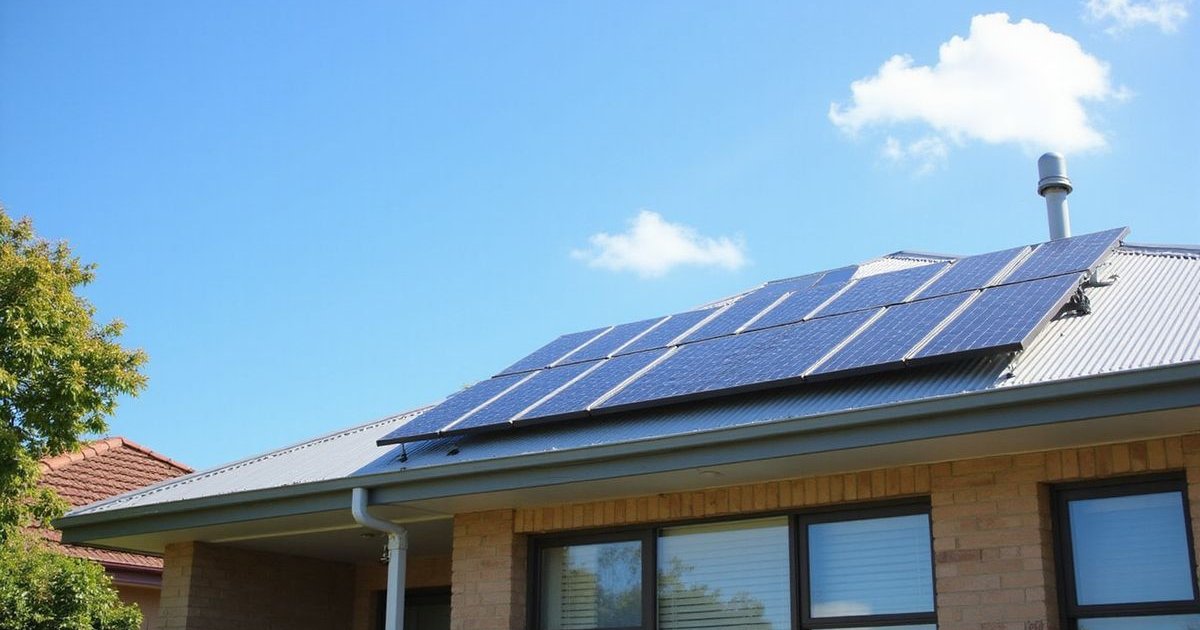
The direction your roof faces significantly affects solar hot water performance, but it’s less “all or nothing” than many people think.
Ideal orientation: North-facing roofs are the gold standard in the Southern Hemisphere. This orientation captures the maximum solar radiation required to heat a 300L tank efficiently, especially during Perth’s shorter winter days.
Acceptable alternatives:
- Northeast or Northwest: These are still excellent options. Research indicates that a deviation of up to 45 degrees from due North typically results in only a 5-10% drop in efficiency, which is often negligible for average household usage.
- East-facing: This captures the morning sun. It is a smart choice for families who do their heavy water usage (showers, laundry) in the morning, allowing the tank to recover temperature early in the day.
- West-facing: This targets the intense afternoon sun. It suits households that use most of their hot water in the evening, as the water is heated just before peak usage time.
Challenging orientations:
- South-facing: A south-facing roof receives the least direct sunlight. We generally advise against installing collectors here, as the system will rely heavily on the electric or gas booster, effectively negating the energy savings.
2. Roof Angle (Pitch)
The angle of your roof determines how directly the sun’s rays hit the collector plates.
Optimal angle for Perth: Because Perth sits at a latitude of approximately 32° South, the perfect angle for year-round efficiency is roughly 30-35 degrees. This pitch balances the high summer sun with the lower winter sun.
The “Good Enough” Zone: Most residential roofs in Perth are built with a pitch between 20° and 25°. While this is slightly lower than the theoretical optimum, the efficiency loss is less than 5%. You rarely need tilt frames unless your roof is significantly flatter than 15 degrees.
Steep roofs: Pitches over 45 degrees are rare in standard Perth project homes but can be found in character homes. These capture winter sun brilliantly but can overheat in summer, so we often install a temperature relief valve to manage the excess heat.
3. Available Space
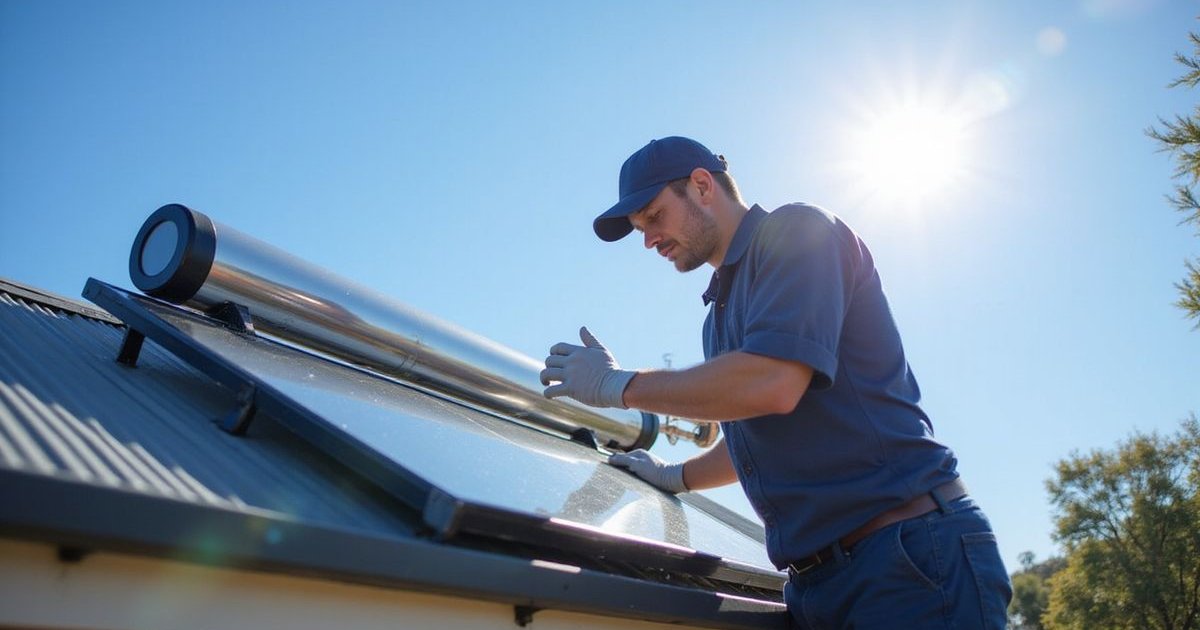
Solar collectors are physically large, and you need more than just the exact footprint of the panels.
Standard Dimensions:
- Small system (150-200L): Requires 1 collector panel (approx. 2m²).
- Medium-Large system (300L+): Requires 2 collector panels (approx. 4m²).
- Roof-mounted tanks: A “close-coupled” system (tank on roof) needs an additional 1.5m x 2.5m clear space, bringing the total required area to around 6-8m².
The “Setback” Rule: Installers cannot place panels right on the edge of the roof. Australian Standards (AS 1170.2) generally require a clearance zone from the roof edge and ridge cap—often around 20% of the building’s dimension—to prevent wind uplift damage.
4. Structural Integrity
This is the most critical safety check we perform.
The Weight Factor: A standard 300-liter close-coupled system weighs approximately 500kg when full. That is half a tonne of water sitting on your rafters.
Structural Requirements:
- Truss Spacing: The tank must span across at least two (ideally three) roof trusses or rafters to distribute the load evenly.
- Maximum Gap: Rafters should be spaced no more than 900mm apart for standard installations.
- Timber vs. Steel: Older jarrah timber frames are incredibly strong, but modern lightweight steel trusses may require additional strengthening or “blocking” to support the point load of a heavy tank.
Split systems (collectors on roof, tank on ground): These are much easier on your structure. The roof only carries the collectors (roughly 40-80kg), making them the safer choice for older homes with questionable roof health or modern homes with lightweight trusses.
5. Roof Condition
Your solar hot water system will likely last 15-20 years. Your roof needs to last just as long.
The costly mistake to avoid: Installing a new system on an old roof is a financial risk. If you need to replace your roof sheeting or tiles in 5 years, you will have to pay a plumber $600-$1,000+ to decommission, remove, and then reinstall the solar unit.
What to check for:
- Rusted screws/nails: A sign that sheeting is loose.
- Brittle tiles: Concrete tiles from the 1980s can snap under foot traffic.
- Sarking damage: If the insulation paper under the tiles is torn, leaks are harder to detect until they damage the ceiling.
6. Shading
Even a small amount of shade can disproportionately impact performance.
The “Partial Shade” Problem: Solar thermal collectors work differently than solar PV panels. If the bottom third of a collector is shaded by a chimney or vent pipe, it can stop the natural “thermosiphoning” flow of water, significantly reducing the system’s overall heating capacity.
Assessment tools: We use pathfinder tools or satellite imagery to check for winter shading. Remember, the sun is much lower in the sky in June and July, meaning a neighbour’s two-story extension might cast a shadow then that isn’t visible in January.
The 9-to-3 Rule: For the system to generate enough STCs (Small-scale Technology Certificates) to qualify for rebates, it generally needs clear solar access between 9:00 AM and 3:00 PM.
Common Perth Roof Types
Colorbond Steel Roofing
This is the most common roofing material on modern Perth homes.
- Suitability: Excellent.
- Mounting: We use non-penetrative clamps (like Klip-Lok) where possible, or standard L-feet with rubber EPDM washers.
- Maintenance Tip: The rubber washers on mounting screws can degrade faster than the metal. We recommend checking them every 10 years to prevent leaks.
Concrete Tile Roofing
You will see these on thousands of homes built between the 60s and 90s.
- Suitability: Very good, but requires care.
- Mounting: Installers must use proper tile hooks that slide under the tile.
- Installer Warning: A quality installer will grind a small channel in the tile so the hook sits flat. Skipping this step (“kick up”) can cause the tile to crack under the weight of the collector.
Terracotta Tile Roofing
These are beautiful but notoriously fragile.
- Suitability: Good, but high risk.
- Mounting: Requires specific, wider hooks to avoid point-loading the clay.
- The “Spare Tile” Rule: We always ask homeowners to have 10-20 spare tiles on hand before we start, as walking on terracotta almost invariably leads to a few breakages regardless of care.
Flat or Low-Pitch Roofing
Common on commercial builds or modern architectural homes.
- Suitability: Requires tilt frames.
- Mounting: Panels are mounted on triangular frames to lift them to the 25-30° range.
- Wind Load: The wind catches these raised panels like a sail. This setup requires significantly more fixing points to meet wind region standards.
What If Your Roof Isn’t Ideal?
Sometimes the roof just won’t work. The good news is that technology has moved on.
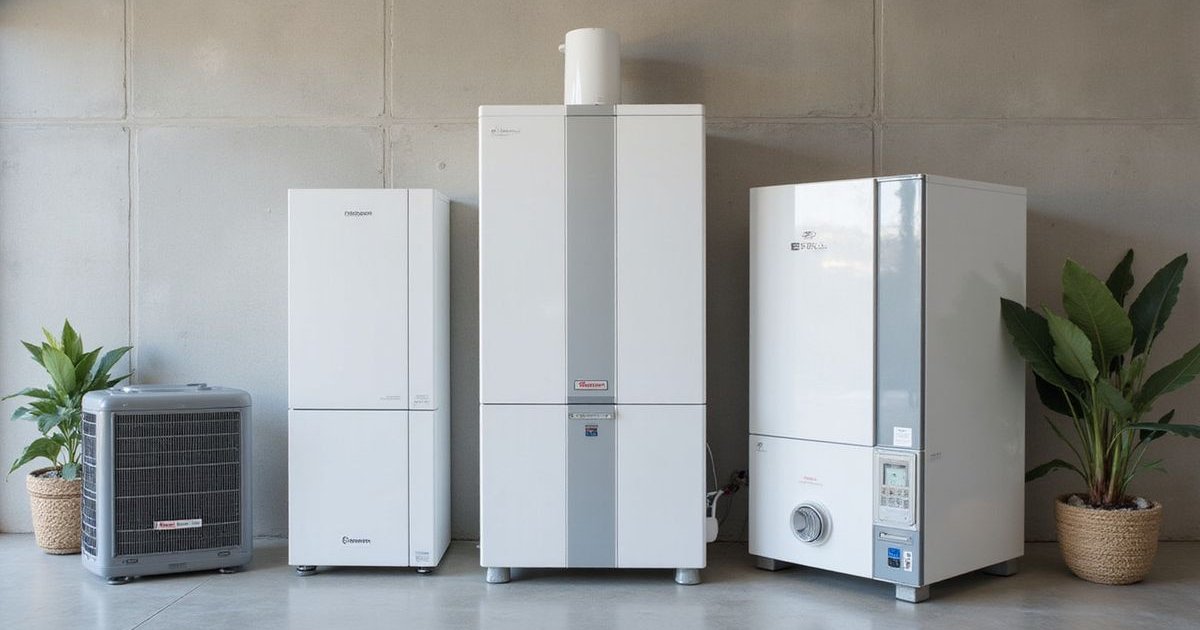
Heat Pump Hot Water Systems
This is rapidly becoming the preferred choice in Perth for homes with difficult roofs.
- How it works: It looks like a standard AC unit and sits on the ground, extracting heat from the ambient air.
- The Advantage: It doesn’t need roof panels. It works day and night, rain or shine.
- Top Performers: In 2025, we are seeing exceptional results from units like the iStore and Reclaim Energy models. They are quiet, highly efficient (COP of roughly 4.0), and qualify for the same STC rebates as roof-mounted solar.
Ground-Mounted Collectors
If you are committed to thermal solar but have no roof space, collectors can be mounted on a frame in the backyard.
- Requirement: You need a clear, unshaded patch of ground near the house.
- Cost: Expect to pay an extra $500-$1,000 for the custom ground frame and trenching for pipes.
Split System Configuration
If your roof structure is weak but you have good sun:
- Solution: Put the heavy tank on the ground and only the lightweight panels on the roof.
- Benefit: This reduces the roof load from 500kg to under 80kg, making it viable for almost any structure.
Professional Assessment
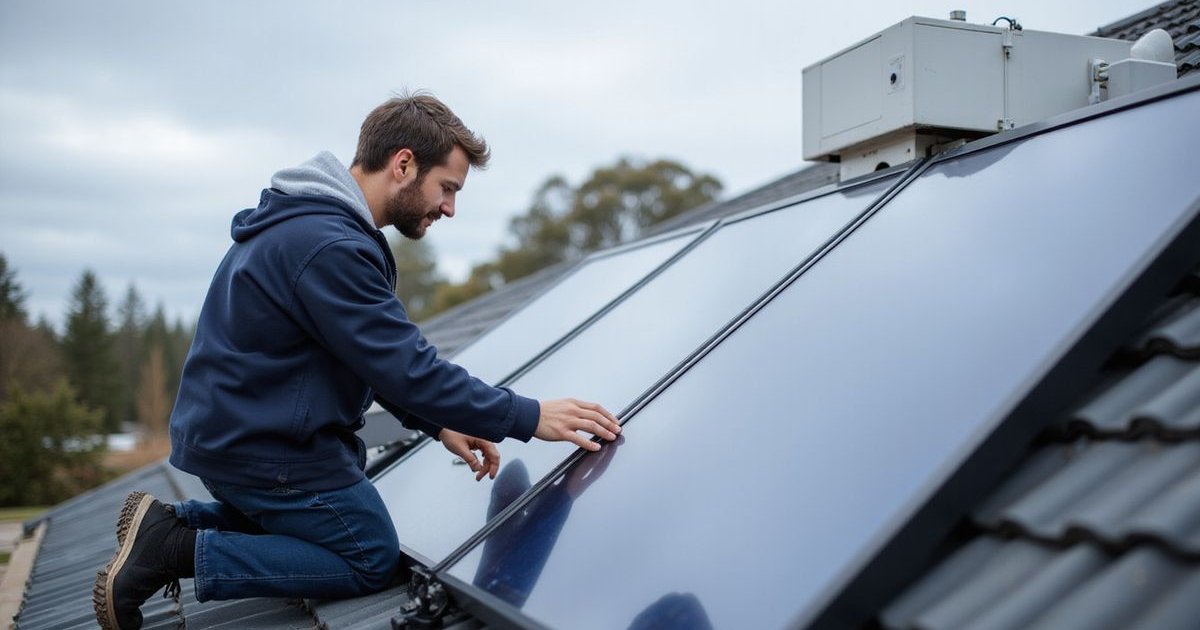
A proper site assessment isn’t just a glance at Google Maps.
What we evaluate:
- Exact Roof Pitch & Azimuth: Measured with digital tools.
- Structural Load Path: Checking that the weight transfers down to load-bearing walls.
- Shading Analysis: Using solar pathfinding tools to predict winter shade.
- Plumbing Route: Assessing the difficulty of running pipes from the roof to the ground (internal walls vs. external conduit).
Perth-Specific Considerations
Wind Region B2 Zones
Perth is generally Wind Region A, but many coastal suburbs (like those in the City of Joondalup or Stirling) fall into Wind Region B. The National Construction Code has specific “Region B2” requirements that treat these areas similarly to cyclonic zones for roof attachments. We must use extra-strength cyclone-rated brackets in these areas to ensure your system stays on the roof during a storm.
Bushfire Zones (BAL Ratings)
If you live in the Perth Hills or fringe suburbs, your home likely has a Bushfire Attack Level (BAL) rating.
- The Requirement: BAL-12.5 to BAL-40 zones often require specific ember guards and non-combustible mounting materials to prevent leaves trapped under the panels from igniting.
Strata Properties
Living in a unit or townhouse?
- The Hurdle: The roof is usually “common property.” You will need written permission from the Strata Body Corporate.
- The Solution: Many stratas prefer split systems or heat pumps because they are less visible from the street.
STC Rebates (Zone 3)
Perth is classified as Zone 3 for Small-scale Technology Certificates (STCs).
- The Benefit: This provides a significant point-of-sale discount (often $600-$1,000 depending on the system).
- The Urgency: The “deeming period” drops every year on January 1st until the scheme ends in 2030. Installing sooner rather than later locks in a higher rebate value.
Next Steps
Ready to find out if your Perth home is suitable for solar hot water? The choice often comes down to balancing your roof’s physical limits with your budget and hot water needs.
Our team at Hot Water System Perth specializes in navigating these local variables. We provide free site assessments to check your structural integrity, wind region requirements, and solar access.
Our assessment covers:
- Roof structure and condition check
- Wind region classification (A vs B2)
- Shading and orientation analysis
- Comparison of Roof-Mounted vs. Heat Pump options
- A fixed-price quote with all STC rebates applied
Contact us today to book your assessment and get a clear, honest recommendation for your home.