If you’ve decided on gas hot water for your Perth home, you’re already ahead of the curve in terms of reliability. But now you face the fundamental choice that splits most households: the traditional storage tank or the modern instantaneous (continuous flow) unit. From what we see on the ground, this isn’t just about preference—it’s about matching the system to your specific plumbing infrastructure.
How Each System Works
Gas Storage Hot Water
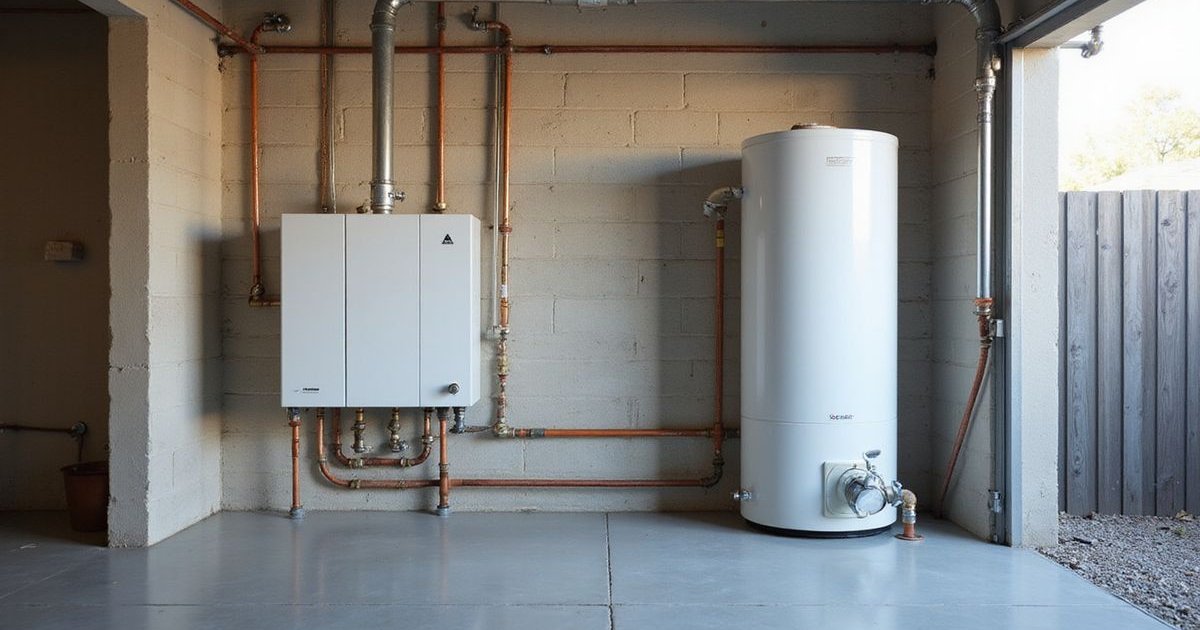
Gas storage systems are the workhorses of Western Australian homes. They maintain a tank of hot water 24/7, ready for immediate use.
- A gas burner heats water in an insulated vitreous enamel or stainless steel tank.
- A thermostat monitors water temperature, typically keeping it above 60°C to prevent Legionella.
- When the temperature drops (due to use or heat loss), the burner fires to reheat.
- Hot water is drawn from the top of the tank while cold water enters at the bottom.
Tank sizes typically range from: 90L to 360L (Common Perth models: Rheem Stellar, Vulcans).
Gas Instantaneous (Continuous Flow)
Instantaneous systems are reactive—they create hot water only when you ask for it.
- Opening a hot tap triggers a flow sensor in the unit.
- Cold water flows through a copper heat exchanger.
- A gas burner ignites, rapidly heating the water as it passes through.
- Hot water is delivered continuously at a pre-set temperature (usually 50°C).
Flow rates typically range from: 16L to 32L per minute (Common Perth models: Rinnai Infinity, Rheem Metro).
Key Differences Compared
Space Requirements
Storage tanks:
- Floor space: Requires a substantial footprint (600mm+ diameter).
- Height: 1.2m to 1.8m tall.
- Clearances: Needs ventilation gaps and easy access for anode replacement.
- Placement: Can be indoors or outdoors, but indoor units require expensive fluing.
Instantaneous units:
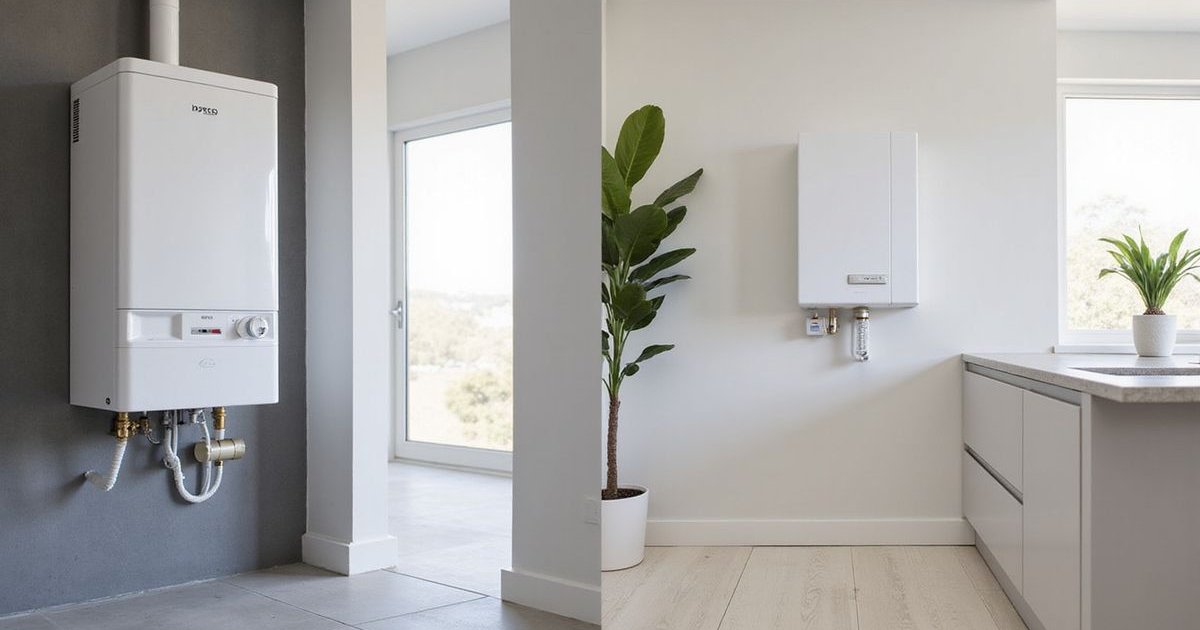
- Size: Roughly the size of a small suitcase (approx. 500mm x 350mm).
- Mounting: Wall-mounted, freeing up valuable ground space.
- Recess boxes: Can be set into the brickwork for a flush finish (popular in new Perth builds).
Winner for space: Instantaneous. We often install these in narrow side passages where a tank simply wouldn’t fit.
Hot Water Availability
Storage tanks:
- Immediate flow: Hot water is there the second you turn the tap (accounting for pipe length).
- Pressure: generally excellent, even with multiple taps open (mains pressure).
- The limit: Once the tank is empty, you face a 45-60 minute recovery time.
Instantaneous units:
- The “Cold Water Sandwich”: You might notice a 2-3 second delay or a brief burst of cold water if you turn the tap off and on quickly.
- Unlimited supply: You can shower for hours without running out.
- Flow limits: If you run two showers and a dishwasher simultaneously, a smaller unit (e.g., 16L/min) may struggle to maintain temperature.
Winner for availability: It’s a tie. Storage wins for immediate pressure; instantaneous wins for endurance.
Running Costs in 2026
Storage tanks:
- Standby losses: You pay to keep water hot while you sleep or work.
- Efficiency: Older 3-star units are gas guzzlers. Newer 5-star models are better but still lose heat.
- Estimated Cost: Approx. $700-$780 per year for a 4-person household in WA.
Instantaneous units:
- Zero standby loss: You only pay for gas when the tap is open.
- Star Ratings: Most modern units (like the Rinnai B26) are 6 or 7-star energy rated.
- Estimated Cost: Approx. $530-$655 per year for the same household.
Winner for running costs: Instantaneous. With ATCO network tariffs rising ~7% in 2025, that $150-$200 annual saving is becoming more significant.
Purchase and Installation Costs
Storage tanks:
- Unit cost: $1,000-$2,000.
- Installation: $400-$800 (usually a simple swap).
- Total installed: $1,400-$2,800.
Instantaneous units:
- Unit cost: $1,200-$2,500.
- Installation: $600-$1,500.
- The Hidden Retrofit Cost: If you are switching from a storage tank to instantaneous, you often need to upgrade your gas pipe size (see below).
Winner for upfront cost: Storage. It is almost always cheaper to replace “like for like.”
Lifespan and Maintenance
Storage tanks:
- Lifespan: 8-12 years.
- The “Anode” Factor: Perth water eats steel tanks. You must replace the sacrificial anode every 3-5 years, or the tank will rust and burst.
- Failure mode: usually a catastrophic leak.
Instantaneous units:
- Lifespan: 15-20 years.
- Maintenance: No anode to replace.
- Failure mode: Parts (like sensors or fans) can be replaced individually, keeping the unit running longer.
Winner for longevity: Instantaneous. A well-maintained Rinnai or Rheem continuous flow unit can easily outlast two storage tanks.
Installation Complexity (The 20mm Gas Pipe Rule)
Storage tanks:
- Gas Input: Low MJ/h rating (burns gas slowly over time).
- Pipe Size: Works fine on standard 15mm (½ inch) copper gas pipes found in most older Perth homes.
Instantaneous units:
- Gas Input: High MJ/h rating (burns gas rapidly to heat instantly).
- Pipe Size: Usually requires a 20mm (¾ inch) gas pipe from the meter to the unit.
- Electrical: Requires a weatherproof outdoor power point (GPO) for ignition.
Winner for installation simplicity: Storage. Upgrading a gas pipe from 15mm to 20mm can add $500-$1,000 to the job if the pipe run is long or under concrete.
Household Suitability
Best Suited for Storage Tanks
Choose a storage tank if:
-
You have “Hills” water pressure
- In suburbs like Kalamunda or Lesmurdie, pressure fluctuations can cause instantaneous units to cut out.
- Storage tanks act as a buffer, delivering consistent flow even when mains pressure dips.
-
You are replacing an old tank on a tight budget
- Avoiding the gas pipe upgrade and electrical work keeps the upfront price down.
- It’s the quickest “emergency” fix if your current tank just burst.
-
You have a large family with simultaneous users
- If three people shower at 7 AM while the washing machine runs, a 360L Rheem Stellar will handle the flow demand better than a single continuous flow unit.
Best Suited for Instantaneous
Choose instantaneous if:
-
You live in a townhouse or have limited space
- Reclaiming that square meter of floor space in a small courtyard or laundry is valuable.
-
You are a FIFO worker or travel often
- Why pay to heat a tank of water for two weeks while you’re on site?
- Instantaneous units sit dormant and cost $0 while you are away.
-
You have teenagers who take long showers
- You will never hear “Mum, the hot water is gone!” again.
- (Though you might need to timer their showers to save on water bills!).
-
You want precise temperature control
- Digital controllers allow you to set the water to exactly 40°C or 50°C, which is safer for young children and elderly residents.
Perth-Specific Considerations
Water Hardness
Some areas north of Perth (like Neerabup and Two Rocks) have water hardness levels exceeding 120mg/L.
- Impact on Storage: Hard water eats anodes faster. You need to check them every 3 years.
- Impact on Instantaneous: Calcium can build up in the heat exchanger, but this is generally less common than tank corrosion.
Gas Availability & Pricing
- ATCO Network: Most of the metro area is connected, but verify if you are in a newer subdivision.
- 2025 Price Hikes: With gas tariffs increasing, the efficiency of a 7-star instantaneous unit becomes a stronger financial argument than it was five years ago.
The “Expansion Valve” Check
In Perth, we often find storage tanks installed without an Expansion Control Valve (ECV) on the cold inlet.
- The Risk: Without this, the pressure relief valve works overtime, dumping hot water and wasting money.
- Our Tip: If you choose storage, insist your plumber installs an ECV to save water and extend the tank’s life.
Making the Right Choice
Quick Decision Guide
| Feature | Gas Storage | Gas Instantaneous |
|---|---|---|
| Upfront Cost | Low ($1,400 - $2,800) | Medium ($1,800 - $3,700) |
| Running Cost | High (~$750/yr) | Low (~$550/yr) |
| Lifespan | 8 - 12 Years | 15 - 20 Years |
| Space Needed | Large (Floor) | Minimal (Wall) |
| Water Pressure | Excellent | Good (Requires min flow) |
| Best For | Large families, older pipes | Small lots, efficiency lovers |
The Calculation
Consider total cost of ownership over 15 years:
135L Gas Storage:
- Purchase and install: $2,000
- Running cost (15 years @ $750/yr): $11,250
- Replacement (likely at year 10): $2,200 (accounting for inflation)
- Total: $15,450
26L Instantaneous:
- Purchase and install: $2,800 (includes pipe upgrade)
- Running cost (15 years @ $550/yr): $8,250
- Replacement: None expected (15-20 year life)
- Total: $11,050
Potential Savings: Over $4,000
Note: These figures are indicative and based on 2025 estimates. Actual savings depend on usage and future gas prices.
Our Recommendation Process
At Hot Water System Perth, we guide you through this decision by looking at more than just the brochure.
-
Checking your Pipe Sizing first
- We measure your existing gas line diameter.
- If it’s 15mm and 20m long, we’ll be honest about the cost to upgrade before you commit to instantaneous.
-
Assessing your Water Pressure
- A simple flow test tells us if a continuous flow unit will work reliably in your suburb.
-
Comparing Long-Term Value
- We calculate the ROI for your specific household size.
-
Providing Fixed Quotes
- No surprises on the day—installation, valves, and disposal of the old tank are always included.
Whether you need the immediate power of a storage tank or the endless efficiency of instantaneous, we are ready to help you make the switch. Contact us today for an onsite assessment.